
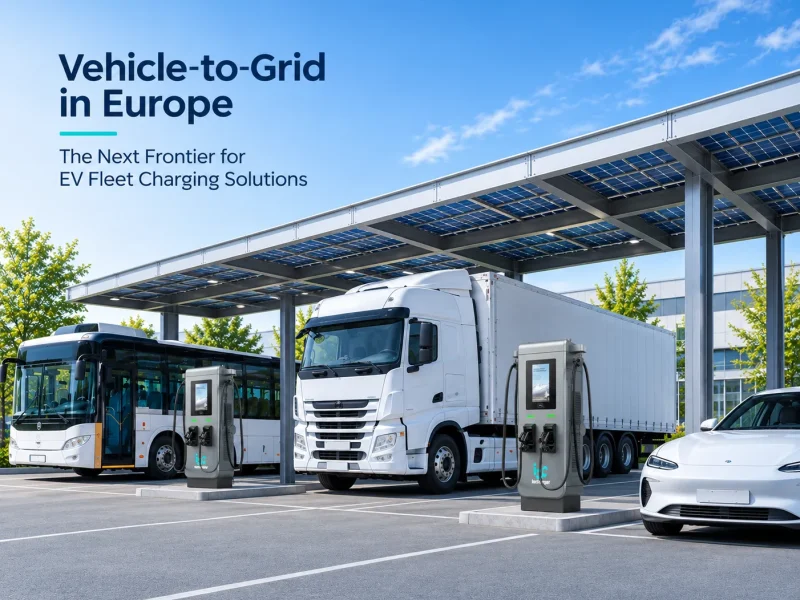
1. What Is Driving the Growth of V2G in Europe?
As Europe accelerates the adoption of renewable energy and the electrification of commercial vehicles, the power grid faces increasingly complex challenges in balancing energy supply and demand. Solar and wind power are intermittent, while the growing number of electric vehicles creates new demands for energy management.
European policies are also supporting this development. Under EU Delegated Regulation (EU) 2025/656, EN ISO 15118-20:2022 will apply to relevant communication interoperability requirements for newly installed or upgraded public and certain private charging points from January 1, 2027. However, this does not mean that all charging stations must support actual bidirectional power transfer immediately.
For logistics companies, bus operators, and large commercial fleets, Vehicle-to-Grid in Europe is creating new opportunities for energy management.
2. How Does V2G Charging Work for EV Fleets?
Traditional EV charging involves one-way power transfer, while V2G enables bidirectional energy exchange between vehicles and the grid.
A typical V2G system includes:
- Bidirectional chargers: Enable power transfer between the vehicle battery and the grid in both directions.
- Compatible electric vehicles: Support the required bidirectional charging capabilities and communication protocols.
- System zarządzania energią (EMS): Coordinates charging and discharging based on electricity prices, grid demand, and vehicle operating schedules.
- Grid connection: Meets the requirements for grid integration, safety, and energy trading.
For example, a logistics fleet can charge its vehicles during off-peak hours when electricity prices are lower, then feed part of the stored energy back into the grid during peak demand periods, provided the vehicles are parked and their next-day operations are not affected.
However, V2G requires compatibility between vehicles, charging equipment, communication protocols, and grid infrastructure. Not all EVs and chargers support bidirectional operation.
3. Benefits and Practical Challenges of V2G for Commercial EV Fleets
V2G creates new energy management opportunities for commercial fleets. However, its value depends not only on potential energy revenue but also on whether it can meet daily operational requirements.
Key benefits include:
- Lower Energy Costs: Fleets can charge during low-tariff periods and, where market access and commercial agreements are available, generate additional revenue through electricity exports or grid ancillary services.
- Improved Energy Utilization: Businesses with solar installations can use EV batteries to store surplus energy and dispatch it according to actual demand.
- Greater Grid Flexibility: By managing multiple EVs as a coordinated fleet, operators can provide flexible power resources for demand response, grid balancing, and local energy management.
Key challenges to consider include:
- Vehicle Operation and SOC Management: Charging and discharging schedules must account for vehicle availability and departure times to ensure that each vehicle has sufficient battery capacity for its next journey.
- Coordinated Management: Coordinating multiple vehicles, charging stations, and energy management systems is a major challenge for large-scale fleet V2G deployment.
4. How iocharger Supports the Future of EV Fleet Charging
As commercial fleets across Europe accelerate electrification, operators need charging infrastructure that combines high-power output, flexible deployment, and intelligent management.
Iocharger provides a range of charging solutions for logistics centers, heavy-duty truck fleets, commercial charging sites, and public charging networks.
High-Power DC Charging Solutions
- Stand-alone DC chargers ranging from 30 kW to 420 kW.
- Split-type DC charging systems ranging from 480 kW to 1,600 kW.
- High-current CCS and MCS charging system for heavy-duty electric trucks.
- Intelligent Charging and Energy Management
- Dynamic Load Balancing (DLB).
- OCPP 2.0.1 and Smart Charging capabilities.
- Future-Ready Infrastructure
Through high-power charging products, open communication protocols, and intelligent management capabilities, IOCharger provides a foundation for today’s commercial fleet charging needs and future expansion into more advanced energy management systems.
For businesses planning V2G projects, bidirectional hardware, vehicle compatibility, ISO 15118-20 implementation, and grid connection requirements must still be evaluated separately.
6. Get Ready for the Next Stage of EV Charging in Europe
The next generation of EV fleet charging will go beyond simply supplying power to vehicles. It will increasingly connect vehicles, charging equipment, energy management systems, and the power grid.
Looking for scalable Rozwiązania w zakresie ładowania floty pojazdów elektrycznych in Europe? Iocharger provides high-power commercial DC charging, intelligent load management, and OCPP-based charging management technology. Contact us to explore solutions for your electric truck fleet, logistics center, or commercial charging project.